
Table of Contents
What Is QUIC?
QUIC (Quick UDP Internet Connections) is a modern transport protocol that improves internet connection speed, reliability, and security. Built on UDP, QUIC minimizes connection setup latency and eliminates head-of-line blocking, a key limitation of Transmission Control Protocol (TCP). It is the underlying transport protocol for HTTP/3, enabling faster data delivery and more stable performance across varying network conditions.
Originally developed by Google and later standardized by the IETF, QUIC now powers a growing share of web communication. According to W3Techs, QUIC is used by 8.9% of all websites, and HTTP/3 adoption has reached 38.7%.
The sections below explain how QUIC works, why it matters, and where it is used.
How Does QUIC Work?
One way to understand the QUIC protocol is to think of it as HTTP/2 + TLS + UDP, operating at the transport layer over UDP in the network protocol stack.
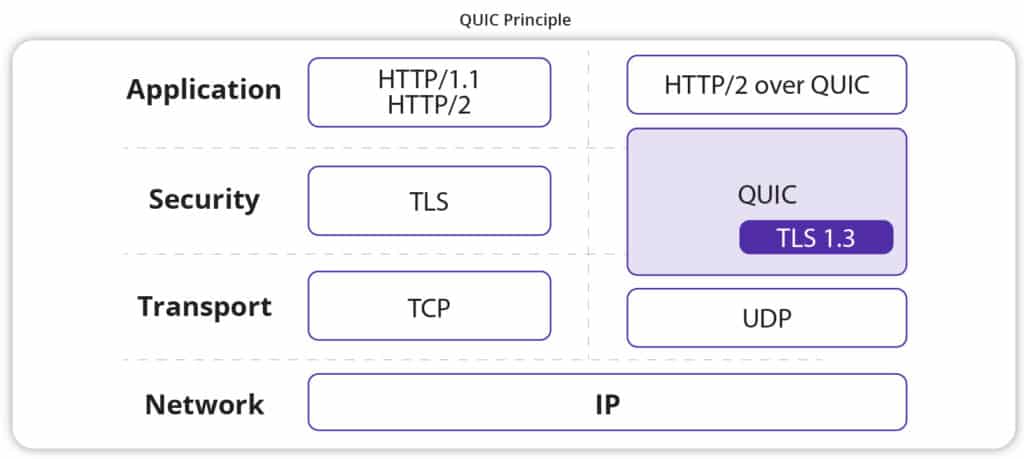
At its core, QUIC uses the UDP protocol as its transport layer, offering lower latency and higher throughput than the TCP protocol while bypassing network middleboxes that often interfere with TCP connections.
QUIC integrates transport layer security (TLS 1.3), improving performance and security compared to previous versions such as TLS 1.2, to establish encrypted TLS connections between endpoints, making it significantly harder for third parties to intercept or manipulate traffic.
By combining the efficiency of UDP, the security of TLS, and the multiplexing capabilities of HTTP/2 at a higher layer, QUIC delivers high-performance transport for today’s internet communication.
What Makes QUIC Better Than TCP?
Traditional TCP-based protocols face limitations in modern network environments, especially in terms of latency, flexibility, and reliability.
QUIC addresses these challenges through several key improvements:
1. Fast Handshake and Connection Establishment
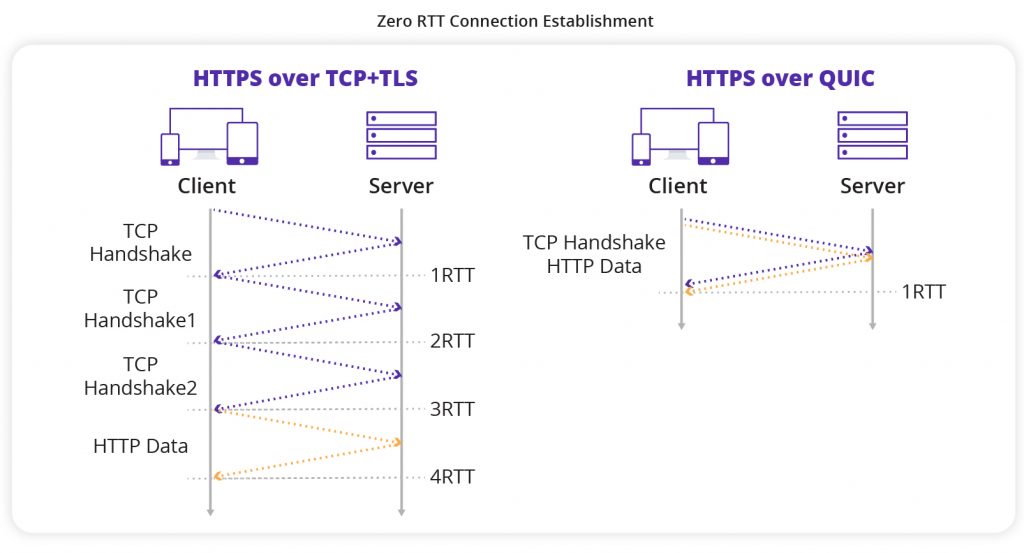
TCP and TLS handshakes require multiple round trips, creating noticeable delays in connection establishment.
QUIC reduces this overhead by using the UDP protocol at the transport layer and integrating TLS 1.3 directly into the handshake process.
It supports 1-RTT connection establishment and enables 0-RTT resumption for returning clients using cached session keys. As a result, a client can send data much earlier after initiating a request, improving performance for modern web applications.
2. Authenticated and Encrypted Packets
The TCP protocol header is not encrypted or authenticated, making it vulnerable to tampering, injection, and eavesdropping intermediaries.
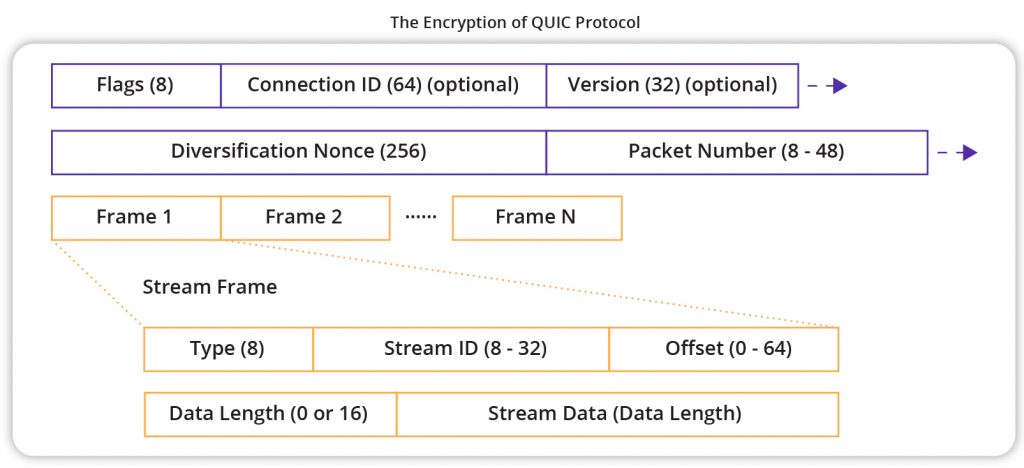
QUIC packets, by contrast, are heavily armed for security. Except for a few unprotected packets used during the initial handshake (like Initial and Retry packets), and all message bodies are encrypted. Any modification to QUIC packets can therefore be detected promptly by the receiving end, effectively reducing security risks.
As shown in the figure below, the content in purple is the authenticated header of the Stream Frame packet, while the yellow part is the encrypted data:
3. Improving Multiplexing to Avoid HoL Blocking
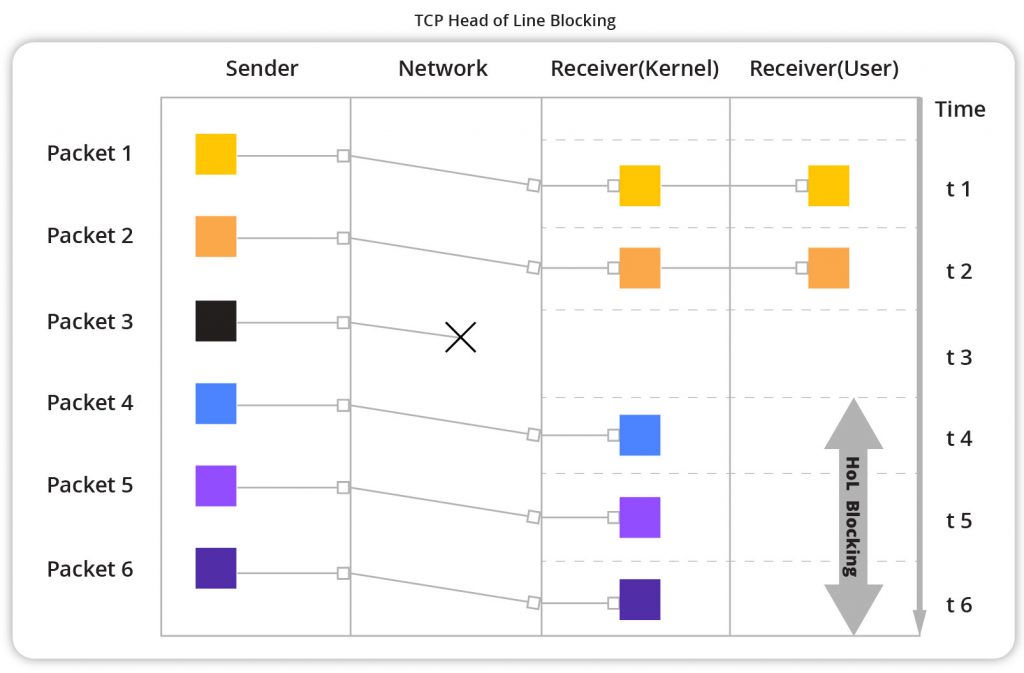
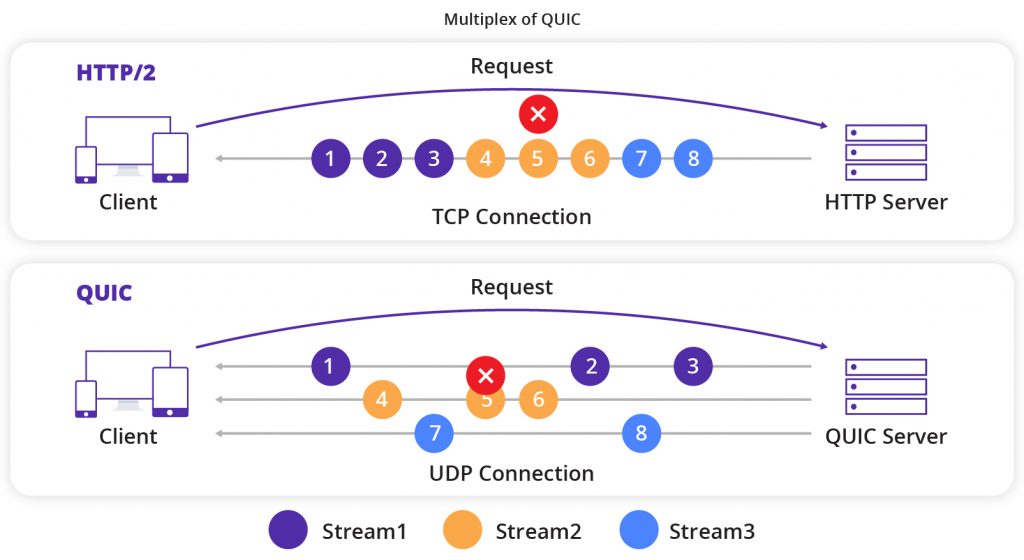
In TCP connections, head-of-line blocking can delay all streams when a single packet is lost.
In HTTP/2, multiple data streams share a single TCP connection and must be delivered in order. If a packet is lost, subsequent data cannot be processed until the missing packet is retransmitted, even if other streams have already arrived.
QUIC introduces multiplexing at the transport layer, allowing each stream to operate independently over UDP, which helps web servers efficiently handle multiple concurrent connections, solving the head-of-line blocking problem that affects the entire connection.
If one stream for example, stream 1 in the picture below experiences packet loss, only that stream is affected, while others (stream 2 and 3) continue data transmission without interruption.
In addition, QPACK, a variation of HPACK header compression, reduces redundant data transmission and further improves performance under unstable network conditions.
4. Pluggable Congestion Control
In traditional network stacks, congestion control is tightly coupled with the TCP implementation in the operating system, making it difficult to update or customize.
QUIC supports pluggable congestion control algorithms such as Cubic, BBR, and Reno, as well as custom algorithms for specific scenarios. These algorithms can be implemented at the application layer without requiring operating system or kernel support, as QUIC is typically deployed in user space.
Different connections within the same application can use different congestion control strategies, while updates can be applied without system upgrades or service disruption.
5. Connection Migration
TCP connections are based on a 4-tuple: source internet protocol (IP), source port, destination IP, and destination port. When any of these values change, the connection breaks.
QUIC connections, however, are based on a variable-length Connection ID. As long as the Connection ID remains the same, the connection persists without disconnection and reconnection.

For example, if a client sends packets 1 and 2 using IP1 and then switches networks, changing to IP2 and sending packets 3 and 4, the server can recognize that all four packets come from the same client based on the Connection ID field in the packet header.
QUIC can achieve connection migration because the underlying user datagram protocol (UDP) is connectionless.
6. Forward Error Correction (FEC)
Packet loss can significantly impact performance, especially in unstable network environments.
QUIC supports FEC, which allows the receiver to recover lost data using redundant packets, reducing the need for retransmissions and improving reliability under poor network conditions.
7. Versioning for Continuous Evolution
Transport protocols like TCP are difficult to evolve because updates often depend on operating system changes.
QUIC introduces built-in versioning, allowing multiple protocol versions to coexist and enabling gradual upgrades without breaking existing connections.
8. Extensibility Through Custom Frames
QUIC also supports extension frames, allowing new features to be introduced without modifying the core protocol. Extensions can be standardized or used privately for specific scenarios, enabling protocol-level innovation while maintaining interoperability.
Where QUIC and HTTP/3 Are Used Today?
As HTTP/3 and QUIC gain wider adoption, their advantages in latency, reliability, and connection stability are enabling a growing range of use cases across different network environments.
Real-time Communication and Streaming
HTTP/3 and QUIC are well suited for real-time communication and streaming such as video conferencing, online gaming, and live streaming, where low latency and stable connections are critical.
QUIC’s connection migration and improved performance under poor network conditions help reduce startup delays, buffering, and request failures.
IoT
In Internet of Things (IoT) environments, devices often operate under unstable and resource-constrained conditions, such as high-speed movement, offshore operations, and mountainous terrain. TCP-based protocols like Message Queuing Telemetry Transport (MQTT) may suffer from frequent reconnections and higher overhead.
QUIC improves efficiency with faster connection establishment and better performance in unreliable networks, reducing disruption and transmission costs.
Cloud Computing
As more services move to the cloud, efficient and reliable client-server communication becomes increasingly important. QUIC enhances cloud performance by supporting multiplexed streams and faster connection setup, improving responsiveness for distributed applications.
E-Commerce and Digital Payment
For e-commerce and payment systems, performance and reliability directly impact user experience and transaction success. QUIC helps ensure faster page loads, more stable connections during peak traffic, and secure data transmission for critical operations.
CDNetworks Delivers Full QUIC Protocol Support
CDNetworks recognized the potential of the QUIC protocol early and took the lead in its development.
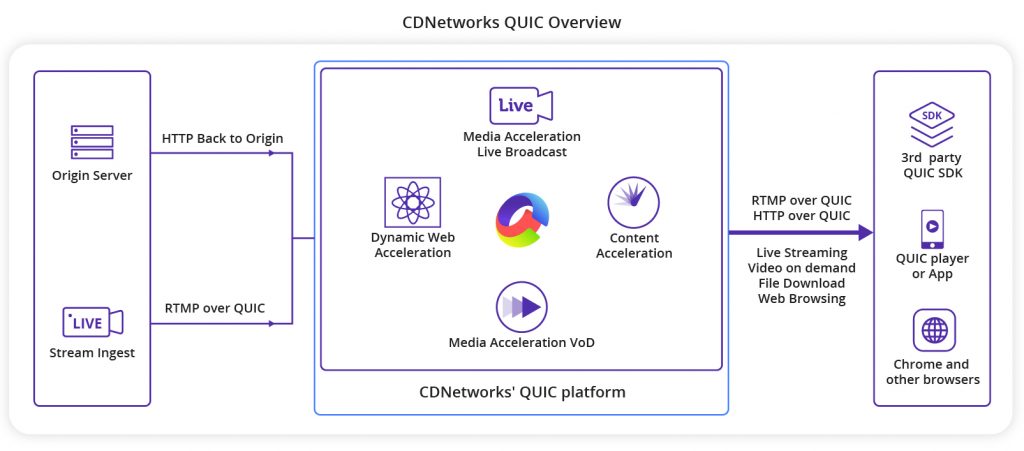
CDNetworks Supports HTTP/3 and QUIC across its full platform, fully upgraded to support all versions of gQUIC (Google QUIC) and the standardized iQUIC (IETF QUIC).

Internally, CDNetworks improved its platform’s frame processing capacity and optimized platform performance to reduce resource consumption.
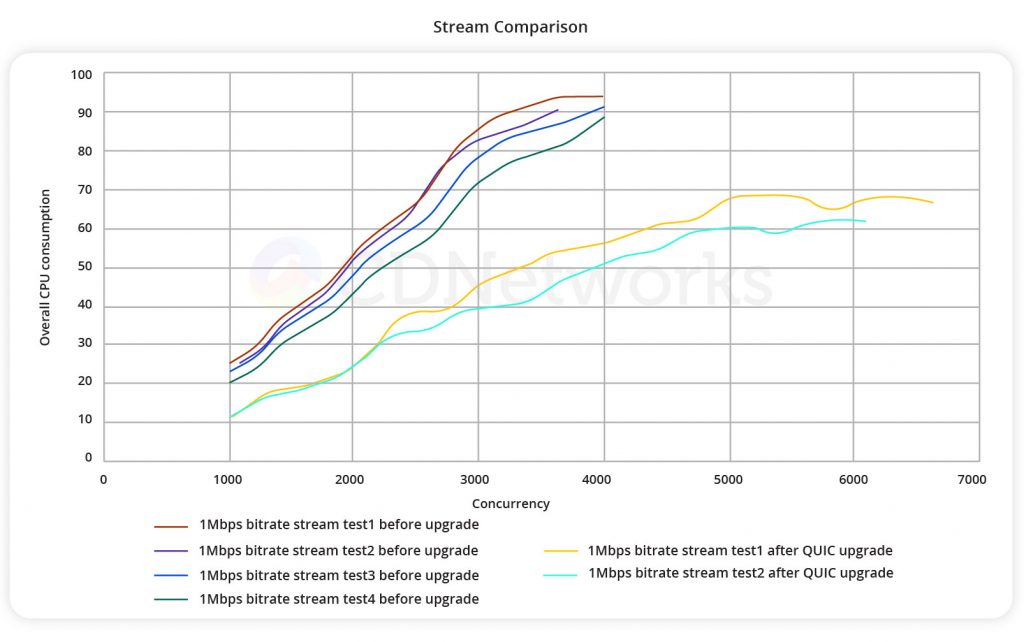
Internal benchmarking shows that in a QUIC stream-pull scenario at 1 Mbps, bandwidth performance improves by 41% under identical concurrency conditions, while average CPU usage drops by 28%.
Specifically for Media Delivery, CDNetworks conducted extensive optimizations to improve QUIC’s retransmission efficiency and rate sampling accuracy. It also refined UDP packet transmission and GSO (Generic Segmentation Offload) strategies, effectively addressing unstable video quality in poor cross-regional network conditions.
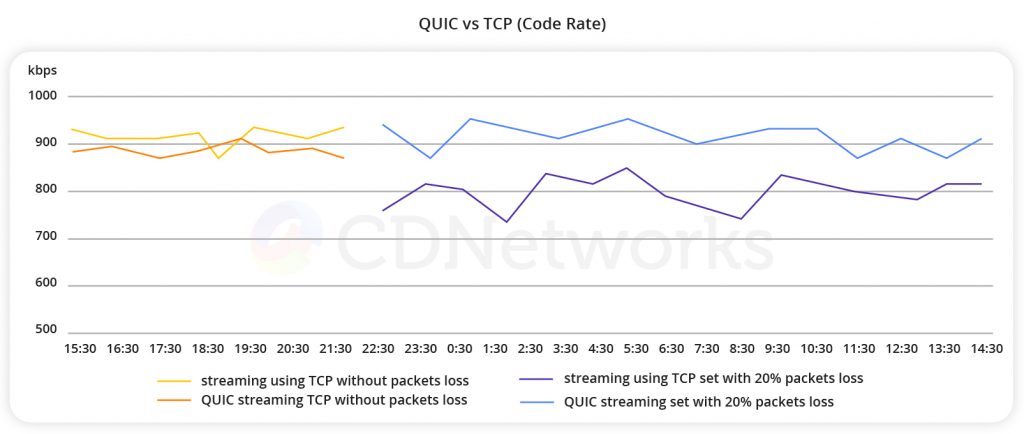
Based on internal testing comparing video playback over QUIC and TCP in a live streaming pull scenario, the following key findings were observed:
1. Bitrate Stability Under Network Loss
In a stable network, QUIC and TCP perform similarly. Under 20% packet loss, QUIC maintains a stable code rate, while TCP performance degrades significantly.
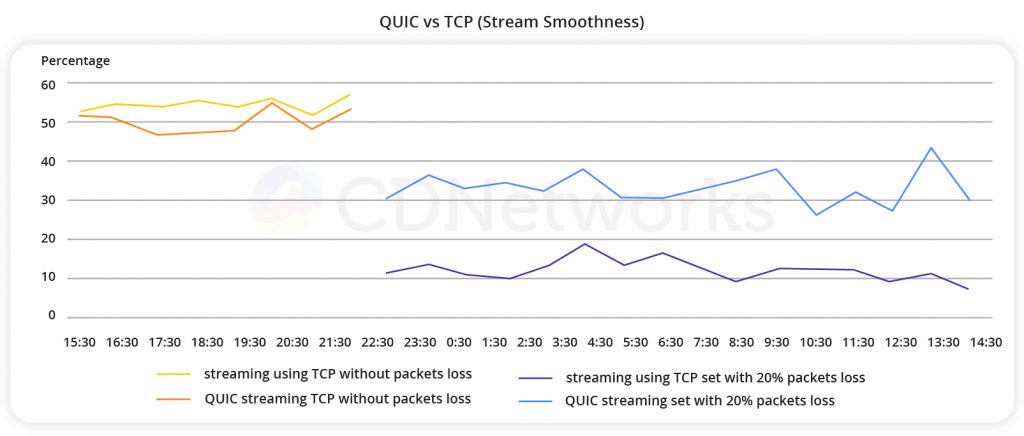
2. Playback Smoothness in Varying Network Conditions
In environments without packet loss, QUIC shows slightly lower smoothness due to additional encryption overhead at the application layer. Under packet loss conditions, however, QUIC performs significantly better than TCP.
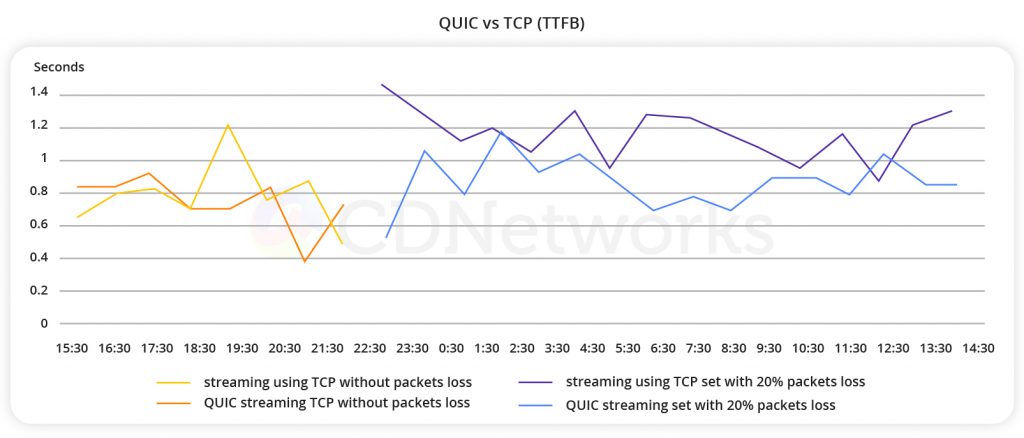
3. Time to First Byte (TTFB) Under Packet Loss Conditions
QUIC maintains consistent first-byte latency under 20% packet loss, while TCP experiences noticeable delays.



To learn more about how CDNetworks can help you with the fastest QUIC streaming, please contact us or click here for a free trial.
QUIC FAQs
What Apps Use QUIC?
Many web browsers such as Chrome, YouTube, Gmail, Google Maps, and Facebook all use QUIC. Many streaming platforms and cloud services are also adopting QUIC.
Should You Block QUIC?
Blocking QUIC suits enterprises needing deep traffic inspection but may degrade user experience and slow down content delivery.
Is QUIC Replacing TLS Protocol?
QUIC integrates TLS 1.3 directly into its protocol, enhancing it rather than replacing it as a security standard.
Why Can QUIC Be a Security Concern?
Encrypted UDP traffic can limit visibility for legacy firewalls and complicate traffic inspection.