Table of Contents
Late-2025 outages across major cloud and edge platforms highlighted a long-standing structural risk: when delivery, routing, and security layers are concentrated within a single provider, failures can propagate broadly, leaving teams with limited options for traffic rerouting or isolation.
Many organizations still operate with a single delivery provider. While sufficient under normal conditions, this approach exposes gaps in failover flexibility, performance optimization, and operational control during disruptions.
As infrastructures grow more distributed and performance-sensitive, businesses are introducing a secondary provider to mitigate concentration risk and improve resilience.
To support this shift, we created the buyer’s guide Breaking Single-Provider Dependency and Strengthening Platform Resilience.
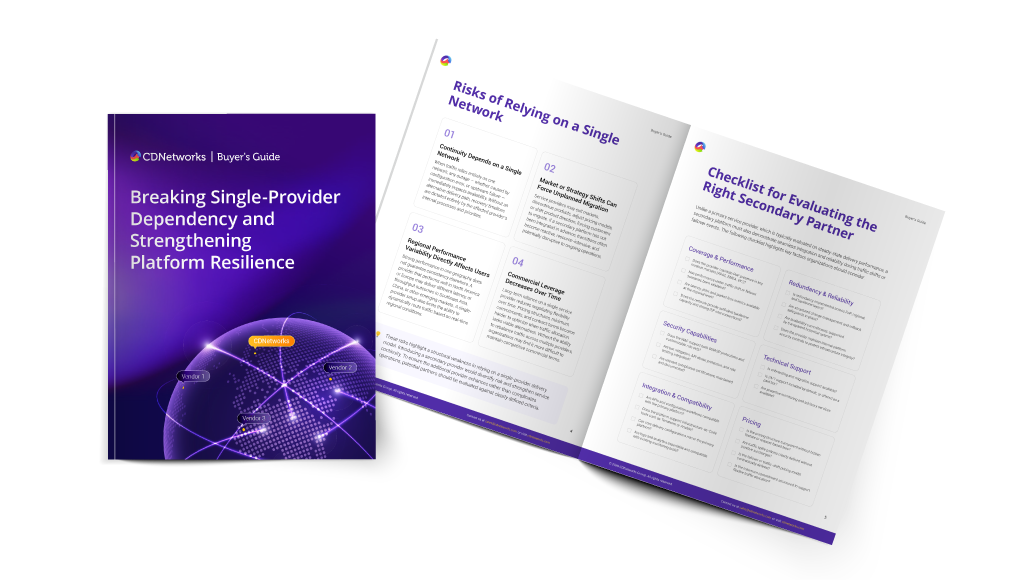
It provides a structured framework for evaluating secondary providers against real operational criteria, helping teams make decisions that hold up under actual traffic shifts, failover events, and performance constraints.
What This Buyer’s Guide Helps You Evaluate
Introducing a secondary platform involves more than adding redundancy. The right partner must integrate smoothly with existing infrastructure and perform reliably during traffic shifts or failover events.
💡 Our guide outlines critical questions to assess a secondary provider, such as:
- Does the provider deliver consistent performance in the regions that matter most to your business?
- Are security capabilities integrated into the delivery platform to protect applications and APIs?
- Can the platform integrate with existing DevOps workflows and configuration models?
- Does the pricing structure support flexible traffic allocation in a multi-provider architecture?
These criteria underpin whether a provider can operate effectively alongside an existing delivery platform.
Who Should Read This Guide?
This buyer’s guide is intended for teams responsible for maintaining availability, performance, and security across distributed applications. Relevant roles include:
- Infrastructure and platform teams managing delivery architecture and traffic routing
- Network and operations leaders accountable for uptime and performance across regions
- Security and architecture teams evaluating integrated protection across applications and APIs
If your role involves maintaining service continuity during incidents, this guide is directly relevant.
Evaluating CDNetworks for Your Multi-Provider Strategy
CDNetworks is one option organizations may consider when establishing a multi-vendor strategy.
Its platform combines global infrastructure, integrated security capabilities, and operational support designed to facilitate an additional delivery layer while maintaining consistent operational workflows.
🚀Key capabilities include:
-
Network coverage with particular strength in emerging markets such as Africa, Latin America, Southeast Asia, and China
-
Integrated security capabilities, including WAAP protection for web applications and APIs
-
API-driven configuration and Infrastructure as Code compatibility, including support for Terraform
-
Expert-led onboarding and 24/7 operational support
These capabilities allow organizations to add redundancy while maintaining consistent operational workflows.
Download the Full Buyer’s Guide
Breaking Single-Provider Dependency and Strengthening Platform Resilience provides a practical framework to:
- Understand the risks of relying on a single provider
- Evaluate secondary providers using operational criteria
- Compare CDNetworks with other leading platforms
📥 Download the full guide → to benchmark providers against real-world performance, resilience, and integration requirements.