Table of Contents
CDN reliability has improved across the industry, yet outages and regional instability still occur. When you rely on a single CDN as your only delivery path, any provider-side incident can quickly become a user-facing issue and a direct revenue risk.
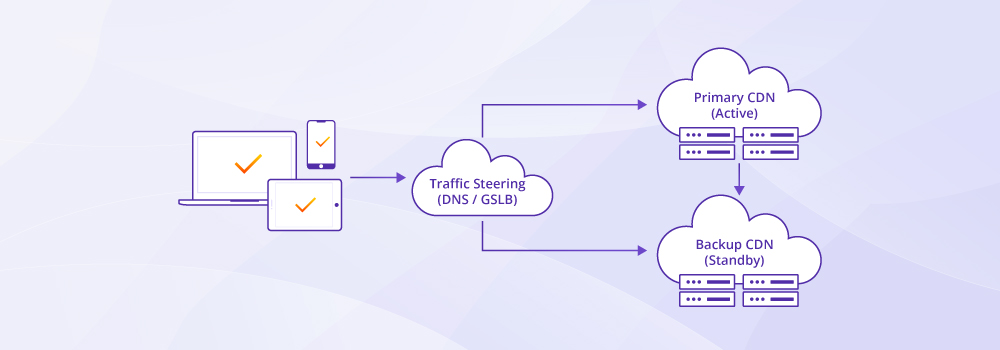
A backup CDN strategy reduces that risk by giving you a tested alternative that can be activated quickly and operated with control.
In this blog, we’ll cover why a backup CDN strategy is essential, what to look for when selecting a backup CDN, and why CDNetworks stands out as a strong option.
4 Business Reasons to Implement a Backup CDN
1. Failover Assurance During Outages and Traffic Surges
Outages happen, even at the largest platforms. In 2025, the industry saw several widely discussed incidents involving major providers, including Cloudflare and AWS. A backup CDN helps ensure your service remains available when your primary vendor experiences an outage. It can also support continuity during major promotions and malicious attacks, when traffic spikes may exceed planned capacity.
2. Avoid Forced Migrations and Unplanned Transitions
Not every migration is a choice. Providers can withdraw from a region, retire a product line, reallocate customers after an acquisition, or enter bankruptcy/restructuring, forcing customers to migrate (as seen recently with Edgio). A backup CDN lowers the risk profile of those moments because your alternative path is already in place. Switching becomes a managed transition rather than a rushed rebuild.
3. Deliver More Consistent Performance across Global Markets
Strong performance in one region does not guarantee the same elsewhere. For global businesses, regional gaps in latency, throughput, and cache efficiency can quickly translate into weaker experience metrics and lower conversion rates. With a backup CDN, you can smooth out regional performance gaps by routing traffic to the best-performing provider in each market.
4. Reduce Vendor Lock-in and Improve Cost Governance
Single-CDN deployments tend to deepen dependency over time, both technically and commercially. Adding a backup provider reduces lock-in, reinforces performance accountability, and improves cost governance. It also gives you leverage to keep service quality and commercial terms aligned with your business priorities, instead of being constrained by one vendor’s terms.
6 Key Criteria to Evaluate and Select the Right Backup CDN
To help teams make that decision with clarity and confidence, we have laid out six actionable criteria based on our operational experience and expertise:
1. Compatibility with Your Existing Architecture
The biggest hurdle in deploying a backup CDN is the fear of a complex re-architecture. A strong backup CDN should integrate cleanly with your current delivery architecture and preserve critical behaviors during failover. In practice, the most effective backup options can be activated quickly without redesigning workflows or rewriting application logic.
Key Considerations:
- Architecture Fit: Validate alignment with your existing topology, including DNS strategy, traffic steering methods, and origin connectivity models.
- Feature Parity: Confirm support for capabilities you rely on most, such as cache rules and cache key control, header manipulation, and edge logic. Pay close attention to regional consistency, as partial availability can create unpredictable behavior and an uneven user experience during failover.
2. Performance Consistency
In a backup scenario, predictability under real traffic conditions matters more than isolated benchmark results. The objective is to consistently deliver an acceptable user experience, especially in the geographies that matter most to your business.
Key Considerations:
- Service Comparability: Validate that the backup CDN can deliver a broadly equivalent user experience to your primary CDN in priority markets.
- Stability and Resilience: Confirm the platform can sustain stable service levels under prolonged production load and includes safeguards that reduce operational and service risk.
- Operational Visibility: Ensure analytics are real-time, sufficiently granular, and actionable enough to determine whether failover improves or degrades end-user experience.
3. Onboarding and Technical Support
Because backup CDNs are often activated under time pressure, structured onboarding and dependable support directly reduce operational risk and improve readiness.
Key Considerations:
- Structured Onboarding Plan: Confirm there is a clear onboarding plan with defined milestones, owners, and readiness checkpoints covering configuration, testing, and go-live.
- Support Responsiveness: Verify response-time commitments, escalation paths, and coverage during off-hours and high-severity incidents.
4. Network Scale and Regional Coverage
A backup CDN must provide sufficient reach and capacity in the regions where your users are concentrated, with the ability to sustain elevated traffic volumes if a failover extends beyond initial expectations.
Key Considerations:
- Global & Local Presence: Confirm that the backup CDN’s network footprint aligns with your primary user regions and actual traffic distribution. Beyond broad global coverage, a strong local presence in priority markets is critical to maintaining consistent performance and stability.
- Capacity Under Stress: Validate that it can sustain elevated traffic volumes for extended periods, not only absorb short spikes.
5. Pricing Transparency
Backup CDN costs should remain predictable across both standby and failover scenarios, with pricing models aligned to backup usage patterns rather than continuous full-traffic operation.
Key Considerations:
- Pricing Predictability: Ensure pricing remains transparent during failover and short-term traffic spikes, with no hidden thresholds, penalty rates, or unexpected add-ons.
- Cost Effectiveness: Evaluate fixed fees, minimum commitments, and feature charges to confirm the solution remains economical in standby or low-usage mode.
6. Future Readiness (Optional)
Many teams initially deploy a backup CDN and later evolve toward a broader multi-CDN strategy or expanded edge capabilities. While future readiness is rarely a primary selection criterion, it often serves as a practical tie-breaker once multiple providers meet core requirements.
For this reason, it is worth assessing early whether the provider can support optional capabilities that may become relevant over time, such as edge compute, advanced security services, media delivery, or AI-driven features.
Why CDNetworks is a Strong Backup CDN Partner
Selecting a backup CDN isn’t just about checking boxes on a technical sheet. It’s about finding a partner who understands that a backup is only as good as its last test. The transition from a primary provider to a backup often happens under intense pressure. This is where CDNetworks differentiates itself. We don’t just offer “another network”; we offer a platform engineered specifically for high-stakes continuity.
We Put Service First.
In backup CDN scenarios, sustaining service during an incident depends on two factors: how quickly the backup can be brought to a validated state and how reliably traffic can be switched under pressure. CDNetworks takes a service-first approach designed to protect enterprise continuity across both.
-
Expert-led support: Our engineers will work side by side with your team to benchmark your current CDN configuration against CDNetworks, identify and address feature-level differences, and ensure consistent behavior throughout migration and ongoing operations.
-
Accelerated onboarding: Rather than leaving you with support documentation and self-service during an outage, we provide expert-led onboarding and will work with your team to prepare and test the cutover path in advance.
We Simplify Integration into Your Existing Workflows.
For a backup to be effective, it must fit into your existing workflow with minimal changes. CDNetworks is designed for high interoperability, ensuring that your transition from a primary provider is seamless without sacrificing the advanced features your application requires.
-
Feature Parity and Logic Mirroring: We support standard edge logic, including custom header manipulation, advanced cache-key control, and complex redirect rules. This allows you to mirror the behavior of providers like Akamai, Cloudflare, or AWS CloudFront.
-
DevOps Readiness with Infrastructure as Code (IaC): We support API-driven configurations and full integration with tools like Terraform. This means your DevOps team can manage CDNetworks using the same automated pipelines and version-control workflows used for your main infrastructure.
-
DNS-Level Flexibility and Traffic Steering: Our platform integrates easily with third-party GSLB providers. Whether you use CNAME-based steering or IP Anycast, CDNetworks slots into your traffic management strategy.
We Provide Transparent Pricing.
A common misconception is that a backup CDN will double your delivery costs. At CDNetworks, we align our pricing with the unique patterns of backup usage, ensuring your “safety net” remains economically viable.
-
Minimal Commitments and Low Standby Cost: We offer flexible entry points that avoid the heavy minimum monthly commitments typically required for primary providers. While on standby, you only pay for the essential infrastructure required to keep your configurations active and synchronized.
-
Predictable Rates during Failover: Outages can drive sudden traffic spikes. We apply the pre-negotiated rate card during failover, so failover traffic is billed at the same rates, without surge premiums.
-
Zero-Cost Origin Protection: Unlike many providers, CDNetworks provides a default origin shield and does not charge for mid-tier cache usage. This significantly reduces egress costs and protects your origin infrastructure without additional line items on your bill.
We Deliver an Expansive Global Network Where Your Customers Are.
CDNetworks provides the geographic reach and capacity profile required for a credible backup CDN partner. Our strong network footprint is able to ensure that when traffic shifts during an outage, you can keep serving users across regions without redesigning your delivery strategy under pressure.
-
2,800 PoPs in over 87 countries and regions with 200+ Tbps CDN capacity.
-
100% network coverage in emerging markets, such as Latin America, the Middle East, Africa, and Southeast Asia.
We Ensure Enterprise-grade Reliability.
As a backup CDN partner, reliability must be engineered as an incident lifecycle capability, not a single feature. Across common outage patterns, CDNetworks applies a layered reliability framework built on three pillars: Change Safety, High Availability Architecture, and Operational Assurance. Together, these controls reduce outage probability, limit blast radius when incidents occur, and shorten time to restoration.
Learn more about how we engineer reliability into our platform →
Start Building Your Backup CDN Strategy Today
A backup CDN is most effective when it is prepared before it is needed. Clear architecture alignment, validated performance, responsive support, and predictable operations determine whether failover remains a plan or becomes a reliable safeguard in production.
CDNetworks helps businesses move from evaluation to readiness with a service-led approach, global network coverage, and reliability controls designed for real outage conditions. By establishing the right foundation early, you can mitigate risk, ensure availability, and maintain control when your primary delivery path is under pressure.
Contact us today for a brief consultation to assess your requirements and determine whether CDNetworks is the right fit for your backup CDN strategy.