Leading Digital Content Platform Protects Original Media Assets from AI-driven Scraping with CDNetworks Bot Shield
Background
The customer is a leading provider of licensed video and music, offering one of the industry’s largest stock libraries with tens of millions of original assets. It equips creators with a comprehensive set of resources to support the production of professional, high-quality content.
As the content economy continues to expand, demand for licensed and original media has grown rapidly. Trusted by filmmakers, content producers, and creative professionals, the customer has become a key enabler of modern content creation, helping them work more efficiently while delivering engaging, authentic, and fully compliant media at scale.
Challenges
High-Value Assets Under Constant Attack
Managing a library of tens of millions of original audio and video content came with formidable security challenges. The platform’s media library and user login/registration endpoints had long been prime targets for automated scraping and malicious traffic.
Bad actors used automated crawlers to extract high-definition, copyrighted assets at scale for unauthorized resale. Meanwhile, AI video generators continuously scraped videos from the platform to train their models.
These activities not only jeopardized the intellectual property of both the platform and its creators but also placed significant strain on system resources, driving bandwidth costs higher and impacting overall platform performance.
Fragmented Security Increased Operational Complexity
Previously, the customer relied on three separate security vendors to safeguard their platform. Juggling multiple dashboards, policies, and workflows increased operational overhead and reduced end-to-end visibility into traffic behavior.
This fragmented architecture made it difficult to respond quickly to evolving crawler techniques and introduced blind spots that sophisticated automated bots could exploit.
Generative AI Escalated Crawler Volume and Sophistication
Over the past year, the rapid adoption of generative AI (GenAI) intensified the customer’s security challenges in three key ways:
-
 Surge in AI crawler traffic: With the rise of GenAI, there was a sharp increase in the volume of automated web crawlers used by AI companies to collect vast amounts of online content for training large language models (LLMs). Over the past year, the customer's platform experienced a significant influx of such AI-driven crawler traffic.
-
 Difficulty distinguishing legitimate from malicious activity: One of the core challenges with AI-driven crawlers was their ability to disguise themselves as legitimate search engine bots. This made it nearly impossible to differentiate between valuable traffic (like search engine indexing) and malicious scraping. As a result, frequent false positives occurred, which disrupted SEO performance and negatively impacted marketing ROI.
-
 More sophisticated crawlers: Motivated by strong financial incentives, attackers adopted more advanced crawlers capable of performing semantic and contextual analysis of web content. These crawlers quickly bypassed static, rule-based defenses, which significantly escalated the difficulty of defending against them.
Solutions
As AI-driven crawlers became a persistent threat, traditional rate limits or static rules proved insufficient. To address these challenges, the customer deployed CDNetworks Bot Shield (part of Cloud Security 2.0), a cloud-based solution designed to detect and mitigate content scraping, advanced persistent bots, AI-driven crawlers, and more automated threats.
Based on the platform’s traffic characteristics and risk profile, CDNetworks implemented a three-layer defense model that combines threat-intelligence-led blocking, context-aware detection, and intelligent control.
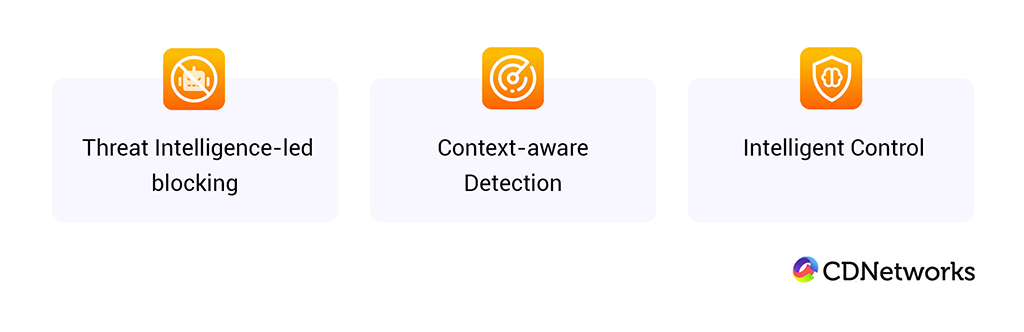
1. Threat Intelligence-led Blocking
Using CDNetworks’ proprietary threat intelligence, known large language model (LLM) crawlers are identified and managed based on IP reputation and user-agent analysis. Unauthorized scraping attempts are blocked at the source before premium assets are exposed.
🚀What this achieves: Effectively curbs scraping from major LLM crawlers (e.g., ChatGPT, Claude, Meta), safeguarding copyrights while maintaining SEO performance.
2. Context-aware Detection
For high-risk endpoints such as user registration, login, and search, CDNetworks applies multiple real-time detection techniques, including client-side validation, to detect and classify traffic within milliseconds.
🚀What this achieves: Enables accurate identification of legitimate crawlers and ensures critical interfaces remain accessible to trusted traffic and protected from automated abuse.
3. Intelligent Control
By analyzing large-scale traffic patterns across both legitimate users and attackers, CDNetworks continuously builds behavioral models such as IP clustering and automated session profiling. These dynamic models enable rapid identification of abnormal activity, even when crawlers attempt to evade static rules.
🚀What this achieves: Enhances control over LLM crawling by combining static rules with dynamic behavioral models to detect and block sophisticated threats quickly.
Results and Benefits
- 10M+ malicious crawler requests blocked per day on average
- 90%+ of malicious crawler activity detected in business-critical traffic (login, user registration, etc.)
- Reduced server load and bandwidth costs
- Enhanced SEO performance and user experience
- Creative content effectively protected through unified defenses against DDoS, web attacks, and malicious crawlers
In an era of AI advancement, business security demands more intelligent and precise solutions. Leveraging proprietary threat intelligence and a multi-layered defense system, CDNetworks provides digital content platforms with a reliable path to safeguard their high-value assets.
Industry
Solution
Key Impacts
- 10M+ malicious crawler requests blocked per day on average
- 90%+ of malicious crawler activity detected in business-critical traffic (login, user registration, etc.)
- Reduced server load and bandwidth costs
- Enhanced SEO performance and user experience
- Creative content effectively protected through unified defenses against DDoS, web attacks, and malicious crawlers
More To Explore
Global Gaming Giant Chooses CDNetworks to Deliver Cross-Regional Game Distribution
Leveraging CDNetworks’ robust infrastructure and tailored optimization technologies, the customer successfully overcame the complexities of cross-border game distribution.